Travel Credit Cards
Now it’s time to squeeze maximum value from your points on your way to becoming a Rich Grad Student. Don’t fear the annual fee. Make it pay you back through credits, protections, and status, then use those perks to travel better, for less.
Giorgio Sarro
The Rich Grad Student
If you’re here, you already use cards responsibly, have a good credit score, and hit the right bonus categories. Now learn to squeeze maximum value from your points on your way to become a “Rich Grad Student”. Do not fear the annual fee. Make it pay you back with protections, credits, and status. Learn the benefits. Already know it all? Go read the pro article!
What are travel cards?
Travel credit cards are designed to maximize benefits for travel. Unlike regular cashback cards, which simply return a percentage of your spending as cash, travel cards primarily reward you with points or miles.
Why travel cards exist and how to win
Banks pay airlines and hotels for points both when points are transferred from a bank portal or when you use a co-branded credit card. Cash-back is simple, but travel points can be worth more than cash when you redeem for flights and hotels. The trick is learning point values, using transfer partners, and avoiding bad redemptions. Points are worth more than cash back because it allows airlines and hotels to sell otherwise unsold seats and rooms and on top of avoiding the fees of online travel portals.
Fun math: If you earn 60,000 points and redeem at 2 cents per point, that is $1,200 in travel. If the annual fee is $95, your net is roughly $1,105. If you redeem those same points for 0.8 cents per point as a gift card, you get $480. Same points, wildly different outcomes.
Travel cards for grad students
Keep one general rule in mind: do not open more than five personal cards in any 24-month span (1). With that guardrail, we recommend opening all the following cards shown here. These cards have modest fees that are typically offset by benefits you can actually use as a graduate student or early career scientist who attends at least one conference and takes at least one personal trip each year.
1) Chase Sapphire Preferred (CSP) ($95/year - $100/year in credits): ideal if you followed our advice and already have a Chase Freedom Flex and Freedom Unlimited. Now you can transfer points from those other cards and maximize them with the CSP. Your Chase trifecta is complete!

Signup Bonus: 75,000+ points
2) Hotel mid-tier credit cards: Don't use these cards for anything but hotel expenses. All these cards offer either a free night or hotel credits which are more valuable than the annual fee. All these cards offer status for welcome gifts, free upgrades, free food, late checkout, and point multipliers.
- a) IHG One Rewards Premier ($99/year – One free night).

- b) World of Hyatt ($95/year – One free night)

- c) Hilton Honors Surpass ($150/year - $200/year in credits). If you like to be paid to eat free breakfast.
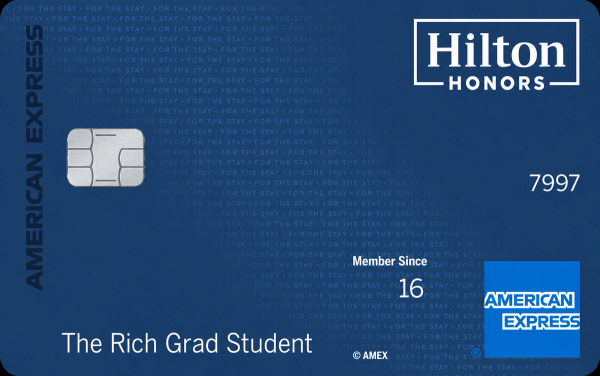
Signup Bonus: 125,000+
3) Capital One Venture X ($395/year - $400/year in credits): If you spend more than $400/yr on travel it’s a no-brainer with the benefits that are unlocked.

Signup Bonus: 75,000+
See our separate article on why co-branded hotel cards can work to our benefit, and why other co-brands do not.
Other travel cards and setups exist and can make sense in specific cases. We own more cards than the ones listed here. We crunched the numbers and believe this lineup offers the best value for graduate students.
Learn the points game
- Cash redemptions often give poor value.
- You will get more value on a bank's travel portal compared to cash back, but you can do better!
- Transfer partners are the secret sauce. Move bank points to airline or hotel programs when it gives outsized value.
- Know your point values. Aim for 2.0 cents per point or better for flights and hotels from credit cards points. Hotel points have lower value.
Tangible Benefits:
1) No foreign transaction fees
All the cards featured here do not charge any fees if you use them abroad, all the while still earning points! Regular everyday cards might charge as much as 3%. Don't pay unnecessary fees. Federal grants usually do not reimburse card fees if you go abroad for work.
2) Airport lounge access:
- Priority Pass membership through Capital One Venture X. You can access 1300+ airport lounges for free. We use it for free meals and drinks no matter the airline or class flown.
- Bank-branded lounges. These tend to be nicer than priority pass, like the Capital One Lounges accessible through Capital One Venture X or the Chase Sapphire Lounges accessible through priority pass. See our blog post on the Capital One Lounge in DFW.
3) Insurance, protections, and why these matter
These are often overlooked, but can be a lifesaver in unexpected situations.
- Trip delay and cancellation coverage can reimburse hotels and meals when weather or carriers fail. For instance, the CSP covers up to $500 per traveler for trip delay. I have used it several times for nice hotels and meals.
- Baggage insurance. If your baggage is lost or delayed, you can get reimbursed for the expenses incurred.
- Primary car rental coverage. Decline the rental car CDW protection. Always check that the coverage is primary and not secondary in the card terms. The CSP, and Venture X cards have primary coverage. This easily saves me $30 per day of rental. Federal grants do not cover domestic CDW.
- Purchase protection and extended warranty are underrated for laptops and research gear. If your item breaks or is lost within 90 days of purchase, both the CSP and Venture X will reimburse you the full amount.
- Fraud protection means disputed charges are removed while the bank investigates. From experience, Chase and Amex are the most reliable at quickly returning your money. The CSP even refunds expenses when a service does not meet expectations. This feature has personally saved me hundreds of dollars each year from issues like fake hotel charges and tourist traps.
- Cellphone protection on the Venture X means that if your phone is stolen, you can get a new one for free.
RGS tip: Insurance companies often try to discourage claims or make the process frustrating, so protect yourself by knowing your policy rights, keeping all receipts and statements, and submitting everything in a clear and organized format. Stay firm. If you are prepared and persistent, they will give in.
Personal experience: I got $1,000 back last year when 10-ft waves canceled our Naples–Sicily ferry ($500 per traveler). The claim was covered under my card’s trip interruption benefit on Chase Sapphire Preferred. We turned what could have been a mess into nice hotels and dinners instead of stress and sunk costs.
4) Status shortcuts
- Hotel Status can bring tangible benefits, including free room upgrades, more points per dollar, free welcome gifts, early check-in and late check-out. This comes with the hotel cards featured above. Free breakfast or credit is also given with the American Express Surpass.
RGS tip: Book directly from the hotel website to access your benefits. If you book with an online travel portal your benefits and points will be forfeited.
- Rental Car Status. See that long line at the rental counter? You can skip it! One of my favorites is Hertz President's Circle status which comes with the Venture X. President's Circle allows me to rent a Prius and drive off with a Jeep 4WD. The American Express Surpass gives National Car Rental Emerald Club Executive status which provides similar benefits.
5) Skip airport lines
The CSP, the IHG One Rewards Premier and the Venture X reimburse the $120 Global Entry application fee every 5 years. Global Entry speeds up reentry into the US by letting you skip the passport line, and it includes TSA PreCheck, which provides access to shorter security lines at most US airports (2). US citizens, permanent residents, and select foreign nationals are eligible. Say hi to your colleagues for me from the lounge while they're stuck in line.
References
(1) https://www.myfico.com/credit-education/blog/5-24-rule
(2) https://www.cbp.gov/travel/trusted-traveler-programs/global-entry